Can an AI Chatbot Help You Through a Breakup? What the Research Says
This is a review of published research on AI chatbots and mental health, written by the makers of OverYou, an app with an AI coach. We have an obvious interest, so we've included the findings that don't flatter AI as well as the ones that do. No study has tested an AI chatbot specifically for breakups. Full references are at the end.
More and more people talk to ChatGPT, Claude or an app's AI coach at 2am after a breakup. Many breakup apps now have one: in our study of 159 breakup apps, 48% mentioned AI in their description. So does talking to an AI actually help? Here's what the research shows so far.
The short answer
Probably yes, in moderation. Trials of mental health chatbots have found real reductions in symptoms of depression and distress over a few weeks. But a large randomized study from MIT and OpenAI found that people who chose to use a chatbot the most ended up lonelier and more emotionally dependent on it. After a breakup, an AI is most useful as a short bridge, something to talk to when the urge to text your ex hits, and least useful as a replacement for the person you lost or for friends.
Key findings
- Chatbots reduced depression and distress on average. A meta-analysis of 15 randomized trials found AI chatbots reduced symptoms of depression (g = 0.64) and distress (g = 0.70), but did not significantly improve overall well-being (Li and colleagues, 2023).
- A generative AI chatbot helped in a randomized trial. In a trial with 210 adults, four weeks with Therabot reduced depression symptoms more than a waitlist: an average drop of 6.13 points against 2.63 (Heinz and colleagues, 2025).
- Even a simple chatbot helped young adults within two weeks. Students who used Woebot for two weeks reduced depression symptoms significantly more than those given an information ebook (Fitzpatrick and colleagues, 2017).
- Heavy use went with worse outcomes. In a four-week randomized study of 981 people and more than 300,000 messages, those who voluntarily used the chatbot more had consistently worse outcomes, including loneliness and emotional dependence (Fang and colleagues, 2025).
- The relationship with the AI matters. People who trusted the chatbot more and felt more socially drawn to it showed more emotional dependence and problematic use (Fang and colleagues, 2025).
What the trials found
Woebot, 2017
One of the first trials of a mental health chatbot randomly assigned 70 people aged 18 to 28 with symptoms of depression or anxiety to either two weeks with Woebot, a scripted chatbot based on cognitive behavioural therapy, or an information ebook from the US National Institute of Mental Health. Woebot users talked to it about 12 times on average, and their depression symptoms fell significantly more than in the ebook group.
The 2023 meta-analysis
Han Li and colleagues reviewed 35 studies of AI conversational agents and pooled 15 randomized trials. Chatbots reduced depression symptoms with an effect size of g = 0.64 and distress with g = 0.70, which are moderate effects. The effect was larger for chatbots that used generative AI, worked in messaging apps and served people with clinical or near-clinical symptoms. They did not significantly improve overall psychological well-being. Users' experience depended mostly on the quality of the relationship with the chatbot and how well it communicated.
Therabot, 2025
Published in NEJM AI, the first randomized trial of a generative AI therapy chatbot enrolled 210 adults with significant symptoms of depression, anxiety or eating-disorder risk. After four weeks, Therabot users' depression scores had dropped by 6.13 points on average, against 2.63 in the waitlist group, and the gap held at eight weeks. Therabot was built and fine-tuned with clinical experts for this purpose, so the result doesn't carry over automatically to general-purpose chatbots.
The warning: more isn't better
The most relevant study for breakups may be the one that found a downside. Researchers from the MIT Media Lab and OpenAI ran a four-week randomized experiment with 981 people who exchanged more than 300,000 messages with a chatbot, in text or voice, about personal, non-personal or open-ended topics. The different set-ups made no significant difference. What did matter was how much people used it: participants who voluntarily used the chatbot more had consistently worse outcomes on loneliness, socializing with real people, emotional dependence on the AI and problematic use. People who trusted the chatbot more and felt more socially drawn to it were more likely to become dependent.
This doesn't prove that heavy use causes loneliness; lonely people may also use chatbots more. But after a breakup, when you've just lost a person you talked to every day, the risk of swapping one attachment for another is real. An AI that's always available and always kind can become the new thing you check at 2am.

How to use an AI after a breakup
- Use it for the moment, not the whole night. The best use is a short conversation when the urge to text or check your ex is strongest. Research on cravings suggests that urges pass if you get through them; see the science of the urge to text your ex.
- Don't use it to analyse your ex. Asking an AI to decode every message or predict whether they'll come back keeps you focused on them. Ask about what you'll do tonight instead.
- Keep a person in the loop. In Li's review, chatbots didn't improve overall well-being, and in Fang's study heavy use went with less socializing. Tell at least one friend how it's actually going.
- Check where your words go. General chatbots may store conversations, and in our study 49% of established breakup apps declared linking user content to your identity. Read the privacy section before writing anything personal.
- An AI isn't crisis care. If you're thinking about harming yourself, contact a crisis line or emergency services where you live.
Limits of the evidence
- No trial has tested an AI chatbot for breakup recovery. The studies above looked at depression, anxiety and loneliness in general.
- Most trials lasted two to eight weeks, and several compared the chatbot with a waitlist or an ebook rather than with a human.
- Chatbots differ a lot. A clinically designed chatbot in a trial is not the same as an all-purpose assistant or a companion app.
How OverYou uses this
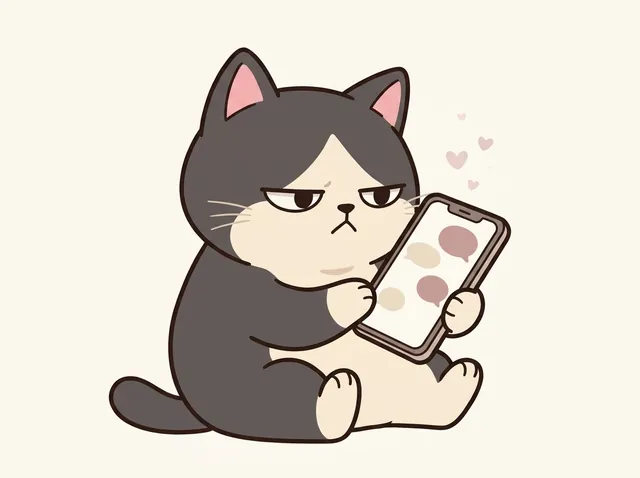
Mochi, OverYou's AI coach, is drawn as a cat and designed for short conversations in hard moments rather than all-day companionship. Use is capped, at 5 replies in the free first days and up to 300 a month with a subscription, and after a conversation Mochi may check in on you the next day. Your messages to Mochi are not stored on our servers, and if you write something that suggests you may not be safe, the app shows helplines where you live. Mochi isn't a therapist, and OverYou is a self-care tool, not therapy.
Sources
- npj Digital Medicine (2023). Systematic review and meta-analysis of AI-based conversational agents for promoting mental health and well-being
- NEJM AI (2025). Randomized trial of a generative AI chatbot for mental health treatment
- JMIR Mental Health (2017). Delivering cognitive behavior therapy to young adults with symptoms of depression and anxiety using a fully automated conversational agent (Woebot): a randomized controlled trial
- arXiv (MIT Media Lab and OpenAI) (2025). How AI and human behaviors shape psychosocial effects of chatbot use: A longitudinal randomized controlled study
Frequently asked questions
Can AI help with a breakup?
It can help in the moment. Trials of mental health chatbots found reductions in depression and distress over a few weeks, though none tested breakups specifically. Heavy use has been linked to more loneliness and dependence.
Is it bad to talk to ChatGPT about my breakup?
Not in itself. Short conversations can help you get through an urge to text your ex. A 2025 MIT and OpenAI study found that people who used a chatbot the most had worse loneliness and more emotional dependence, so keep friends in the loop.
Is there an AI breakup coach app?
Yes. Several breakup apps include an AI coach, including OverYou, whose coach Mochi is designed for short conversations in hard moments.
OverYou is an app for keeping no contact: a streak, a 30-day program, a 30-second pause for when the urge hits, and a place to write the text instead of sending it. Get it on the App Store or Google Play, or see how it works.